This was an art class I took in fall of 2023. It was mostly focused on getting students used to hands-on tools for 3D art. This meant I learned my way around the woodshop, how to plaster and sculpt, how to cast objects, and learned different approaches to presenting items.
This whole class was a learning experience for me, and an entirely different approach to building than what I was used to. My main goal was to experiment with art/building processes I wasn’t familiar with.
The class was split into units titled after their focus.
Unit: Dissasembling
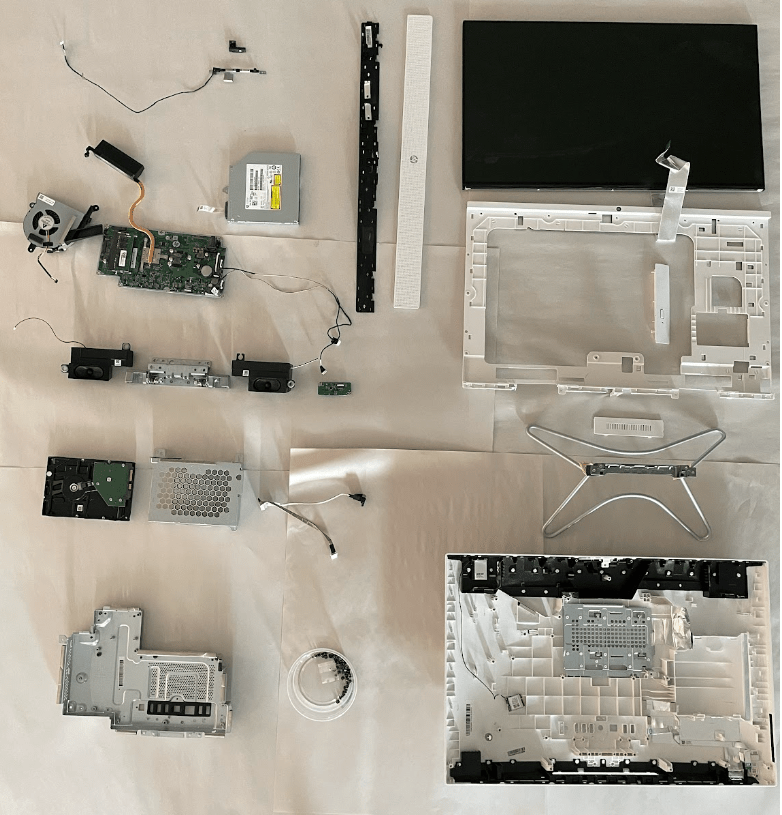
I immediatly deviated from my goal somewhat and decided to dissasemble a nonfunctional computer monitor. It was pretty fun to tear it apart, and many of the peices were precision fit to each other, which added to the challenge.
Unit: Matierial Properties
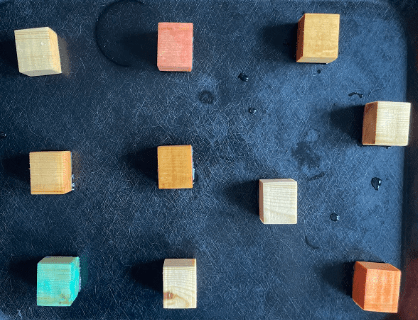
This unit encouraged us to take an experimental approach to something. Very nice and vague, so I decided to see how wooden blocks would be dyed if left in drink liquids for four days. I chose to soak the blocks in water, red wine vinegar, olive oil, iced tea, hot tea, iced coffee, hot coffee, blue powerade, yellow powerade, and orange fanta. The results are shown on the right.
Unit: Formlessness
This was a multi-step project. First, we brought in a random item without knowing what it was for. Then we were told to destroy it in some way, before covering it in paper mache. Then we had the option of covering it in plaster and sanding it, and adding paint if we wanted.
I brought in a sweater. I cut it up, fiddled around with it until I had a shape that appealed to me, and then started paper mache. It was a challenge to get paper mache to stick to the sweater because of the fabric’s flexibility, but I applied 3 layers.
Plastering was also difficult since my project was very organically shaped. Usually plaster is applied with a scraper, but this proved to be so difficult that I gave up and applied it with my hands so I could maintain the organic curves of the shape. There were about 3 layers of plaster. Then I sanded until it was very satisfyingly smooth.

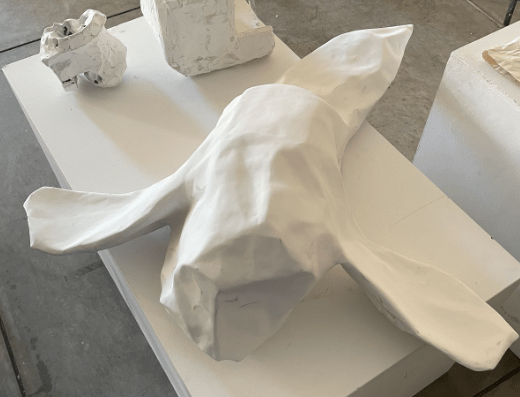

Once we were finished, we were asked to destroy the object, so I sliced mine in two. On the inside you can see I placed a foam block inside the sweater body to add shape to the fabric.
Unit: Pedastals

This unit was to make pedastals to show off any of the objects we had made. I decided to explore organic shapes with plastering even more to display my object from the formless unit. I made a wooden frame with a board attached as the top surface, then placed plastic over it and pulled it around so that it creased nicely in some corners. Then I applied 2 – 3 layers of paper mache, and 3 -4 layers of plaster, before sanding it and then applying a finish.
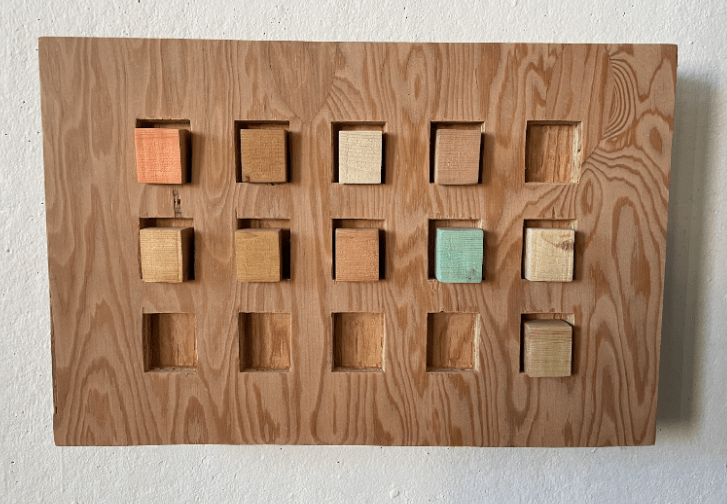
The second pedastal I made was for the colored wooden blocks I had made in the material properties unit. I wanted something wall mounted, because it felt counter intuitive, and I also wanted it to be interactable. I took a wooden board and carefully chiseled slots that were slightly larger than my block dimensions, and sanded the whole thing. I put a french cleat on the back, and voila! A wall mounted pedastal.

Unit: Casting
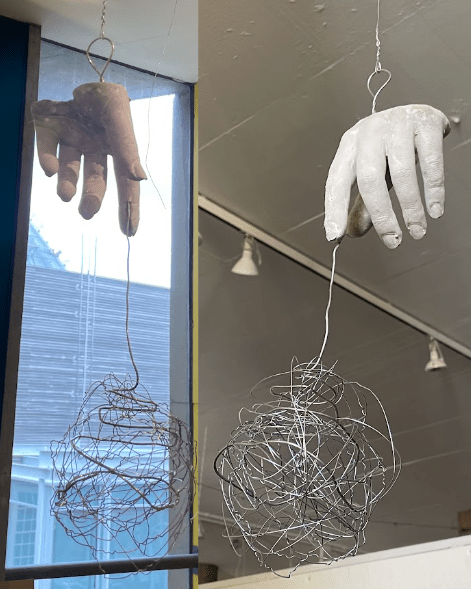
This was towards the end of the semester, so I decided to do something simple. My original idea was to cast one hand with a wire that I would use as the base to make another hand like shape reaching back, but unfortunately I ran out of time to make the other hand. During the process, I was experimenting with different casting materials, both for the mold and for the final object. I decided on an algea based mold, as it was safe on skin and flexible enough to allow me to pull my hand out without damaging it. The object itself is made out of concrete.
 Kade Kelsch